
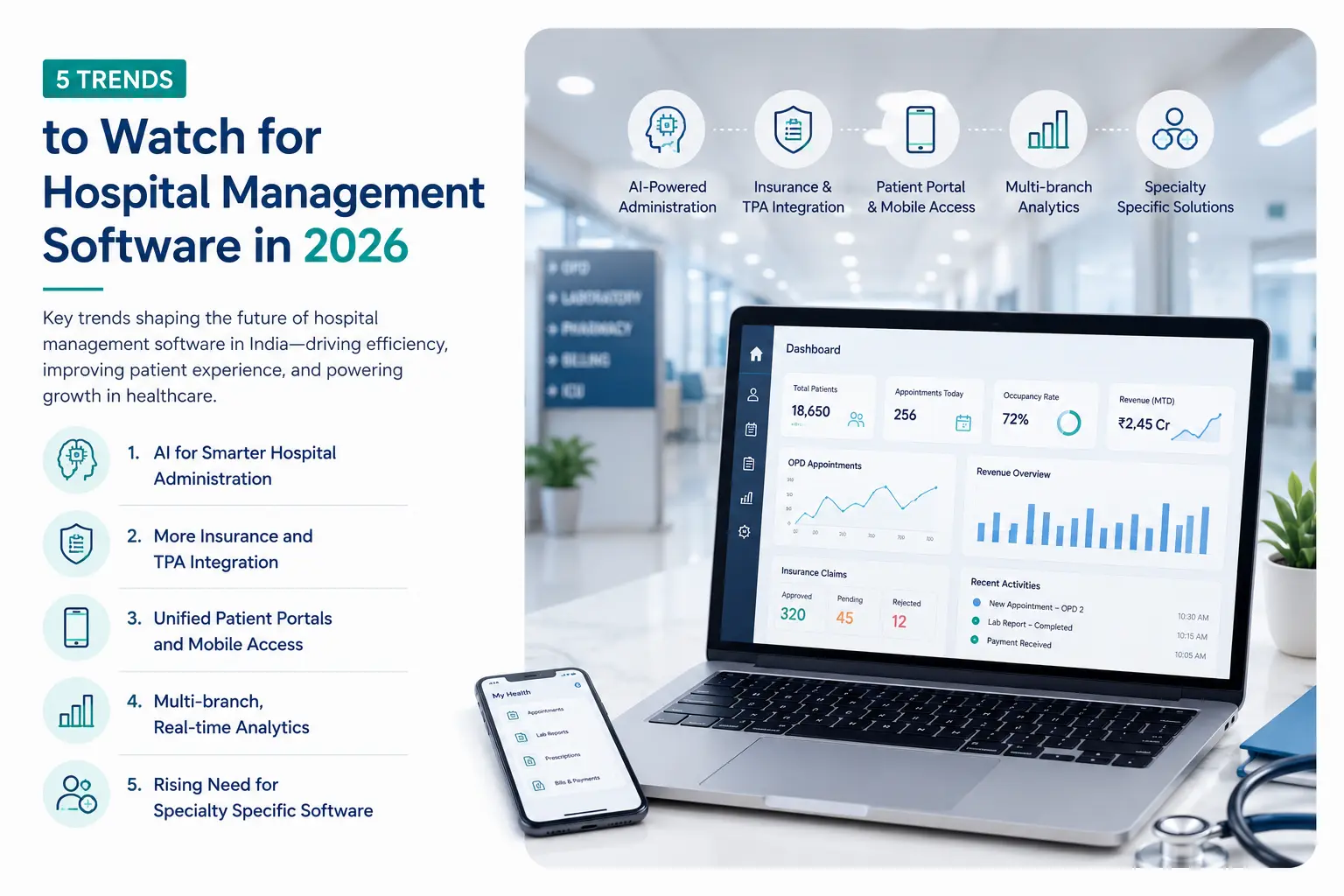
5 Trends to Watch for Hospital Management Software in 2026
The hospital management software in India is changing. This is due to changing patient needs, regulations and a more competitive environment. For hospital owners making management decisions in this environment, it's important to know the direction management software is heading, in addition to the offerings today.
Here are five trends shaping management decisions in the fast-growing healthcare markets across India, including in cities such as Hyderabad.
1. Artificial Intelligence to Assist with Hospital Administration
More and more, we are seeing the integration of highly effective, AI driven, software solutions for the improvement of the hospital administration functions in hospital management software. Some of the innovations addressing the administration function include the following: AI driven suggestions for billing codes; identification of incomplete patient records; and trends analyzing expected patient occupancy for optimal staffing decisions.
These innovations are important, because historically, hospital administration has involved a lot of manual, repetitive functions that are error-prone. AI can eliminate the need for a lot of the manual work the administration staff is required to do. This means hospital staff and management can use their time more effectively.
2. More Insurance and TPA Integration
More and more Indian patients are experiencing cashless insurance claims. This evolution has led hospitals to search for commercial hospital management solutions (HMS) that offer direct integrations to insurance and third party administrator (TPA) portals. Manual processing time for submitting, following up, and reconciling claims is vastly reduced, and cash flow predictability improves.
As claim submissions increase, cash flow predictability becomes more important. For systems with higher insurance-patient volumes, the need for this integration becomes more important.
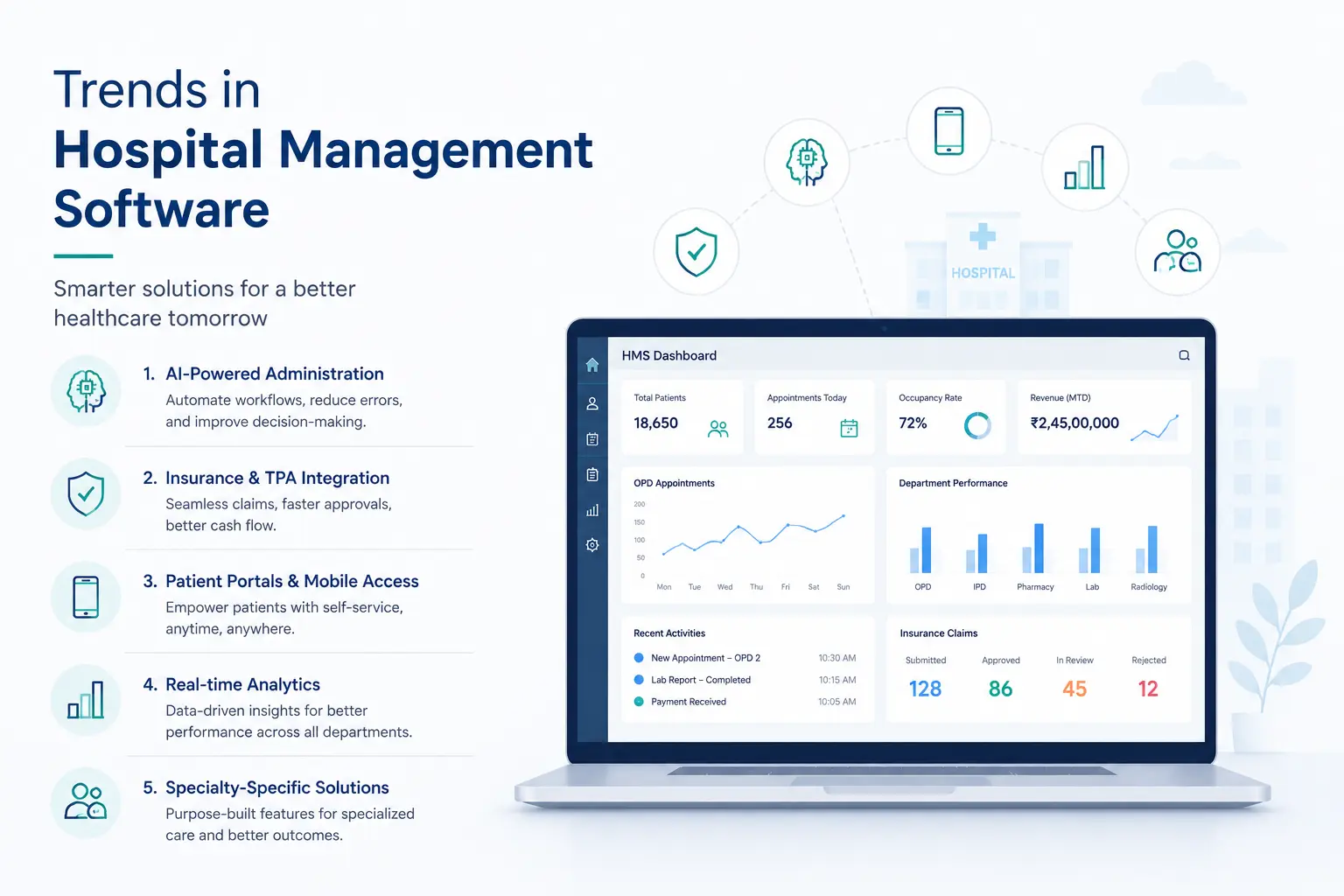
3. Unified Patient Portals and Mobile Access
There has been a shift in patient behavior to expect the ability to complete tasks such as: scheduling appointments, viewing lab results, managing medication, and reviewing and paying bills; from a mobile app. This shift has occurred rapidly over the past several years. There is a clear gap in patient satisfaction and engagement for hospitals that utilize a patient management system that provides advanced portal capabilities. Hospitals that utilize phone and in-person communication to fulfill everyday requests for information are at a disadvantage.
There is an added benefit of decreased telephonic communication to hospital staff. The communications staff that work the front desk are no longer contacted for status requests and confirmations of reports and appointments.
4. Multi-Branch, Real-Time Analytics
With the recent expansions of many successful Indian healthcare providers across many cities and regions, real-time visibility into occupancy, revenue, staffing, and inventory across every branch increasingly becomes a baseline operational expectation as opposed to a premium or optional feature. Consolidated views across all branches is critical for administrators managing multiple locations. Without this feature, administrators must contact individual branches for operational updates.
This is especially important as many hospital systems are still in the planning and implementation phases of expansion. The ability to view real-time data for all branches will eliminate the need to switch hospital management systems mid-expansion to accommodate the growth.
5. Rising Need for Specialty-Specific Software
The traditional, one-size fits all hospital software is being quickly replaced, or at the very least, supplemented by specialty specific purpose-built software. Fertility and IVF clinics are a prime example, as their software needs include highly specialized cycle tracking and embryology records, as well as donor management and milestone-based billing, which generic systems are ill-equipped to offer. There is also a rapidly growing demand for specialty specific systems for the management of dialysis, oncology and other treatment activities, as well as for the management of diagnostic chains.
Increasingly, hospitals with specialized departments are reviewing the ability of a broad generic system to adequately support all the departments and are determining that a generic system is inadequate and a more integrated, specialty specific system is required.
What It Means to Hospital Owners Selecting Providers
The converging demands from both Hospital Management Systems (HMS) users and developers means that more HMS companies are coming up in India. However, not all of them are keeping pace with the changes.
When it comes to evaluating hospital management software providers this year, ask them how their product roadmap addresses the challenges of AI-based administrative tasks, mobile-optimized patient access, multi-branch management, and the flexible framework to support other hospital specialties. This is much better than relying on the snapshot feature list, which may be a few years old.
How Sparta Cloud Solutions Is Addressing the Issues
The Sparta Cloud Solutions team has a better understanding of these issues with our close collaboration with hospitals and fertility clinics in Hyderabad. Because of this collaboration, we have a better understanding of the growing needs of users, which allows us to focus on the features that are most important to our users. Because of this, we have focused on the issues that are critical to our users ahead of other vendors.
Want to find out what new features your software needs to be competitive? Schedule a consultation with us to find out.